
What is a career and technical education center?
[read_meter]
A career and technical education center helps students improve job skills in a hands-on setting. As a result, these environments should be a key focus and development area for school administrators and their world class CTE programs.
Also, note that high schools and colleges around the world were the original CTE work centers. They will continue to play a major role in these essential environments and spaces.
In order to thrive in today’s world, the career and technical education center of the future must expand its reach beyond traditional school boundaries and seamlessly integrate into the daily lives of individuals, communities, and economies they aim to support.
Why are career and technical education centers so important?
Career and technical education centers are important because they provide developing students access to more realistic training and work environments as they develop their proficiency. These environments are critical gateways that enable CTE students a place to activate their knowledge learned from early courses and apply it in realistic practice and work situations.
Characteristics of CTE centers
As schools quickly implement professional and technical training programs, the development of these centers is a natural next step. Although their use is still in its early stages, so the characteristics and implementation of these centers may vary. However, we will describe below specific key characteristics that are beginning to emerge.
Ownership and stakeholders
The primary managers and accountable party for the center. This can be a school work center, a non-profit, a for profit, government entity or a hybrid of all these things.
- Schools – This can include primary and secondary institutions as well as private training institutions.
- Non-profits – Many non-profits provide the environments generally will their support services wrapped around them.
- Government entities – Federal, state, county and local governments generally have employment centers that serve as work centers.
- Private businesses – Many businesses, both large and small at times development work centers for different reasons.
- Hybrid – These centers are operated by a combination of public, private, government and non-profit entities.
CTE program component alignment
This is the way in which the center integrates into an overall CTE program. Examples include how teachers and coaches provide instruction in the center, CTE pathway integration, and other items.
- CTE framework integration – The career and technical work center connects and integrates directly into CTE programs.
- Pathway integration – The center integrates into either one or many different pathways.
- Integration of curriculum and course activities- This is the application of course activities or curriculum at the center.
- Teacher and coach integration – If teachers or coaches will directly instruct or support users at the center.
- Dual enrollment programs – In these programs the work center often sits as the central common feature between students at different schools in the program.
Collaboration format
Since many people often go to a career and technical education center there will aways be some form of group collaboration. This can range from independent study or work to a defined work team.
- Independent study and work environments – Individuals or students may study or work by themselves at the work center.
- Ad-hoc collaborative teams – The center can serve as a meeting place for groups that are working on a project or unified goal.
- Social meeting place – Groups of people could use the center simply for fun.
- School project team – Students can use the center to work on group based school assignments
- Employed work team – Work teams can use the work environment to perform group work tasks or activities.
Connectivity format for users
The way in which users connect virtually or physically to use the center. For highly technical disciplines like information technology a center may be virtual. However, where physical equipment or activities must take place may require a physical center. Finally, there are also hybrid formats which are a combination of both.
- In person access – The center is a physical location and users must physically go to the center.
- Remote access – Users virtually connect to the center.
- Hybrid access – A combination of in person and remote access.
Learning characteristics
Learners may use a career and technical education work center in different ways. This may be through self-study or as part of a course.
Libraries – Libraries serve as a form of career and technical education work center in an education sense.
Courses – It is common for delivery of courses in various formats at a work center.
Study center – The environment might be a location where people independently learn.
Training characteristics
The manner in which students can use the center to practice their tech proficiency. This will also include how coaches and experts provide feedback for training users.
- Gaming environments and labs – These environments let users access and often compete in a game-like development format. Here is an example of a cyber security lab.
- Certification programs – Some of the larger certification programs often act as a form of a career and education work center
- Unpaid internships – Developing talent may participate in performed in unpaid internships are a form training opportunity for work center.
Work characteristics of a career and technical education center
The level of employment for users of the center. This can range from paid internships to full-time work opportunities.
- Different types of internships– Users can work on different types of internships at the center. These are generally short-term work experiences that may use space or equipment at the center.
- Part-time and full-time jobs – These can range from entry level part time to full-time work experiences that are performed at the center in full or as a component.
- Apprenticeships – Apprenticeships provide on the job training and are structured work experiences that can occur at a center. Performance on apprenticeships can occur at the center.
Types of career and technical education centers
The development of career and technical development center is a newer concept for schools as CTE programs continue to expand at schools. Previously, these centers were the responsibility of future employers.
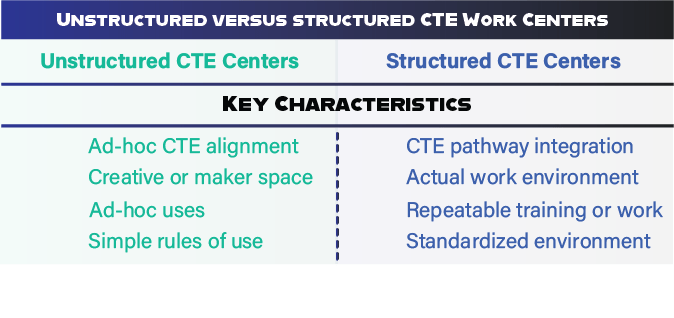
However now a days, these lines are blurring and schools are developing their own ones. With that said, there are really two types of career and technical education centers. They include both structured and un-structured centers
An un-structured career and technical work center
An unstructured career and technical work center is one that primarily just has a work space and associated equipment. As illustrated in its name, these environments are unstructured and do not align to any specific use.
They can range from just an office space, to a creative space, often times called a “maker space”. In this use case developing talent can come and work on creative or career related projects.
These environments can also be virtual. Some examples of these environments are gaming labs in technology. These experiences let students practice in gamified work realistic situations and environments. A key element of these environment is they are generally self-directed by the student. Also, they are loosely aligned to a specific CTE course or program.
Structured CTE work centers
Structured career and technical work centers are designed to provide measurable and standardized user proficiency improvement through their use. These standardized training and work places can be physical locations, virtual environments, or hybrid environments like unstructured centers. They may also be referred to as technical work residency centers.
They will commonly integrate directly into CTE frameworks and pathways when school are stakeholders in a center.
Also, on the other end of the spectrum they will commonly directly integrate into employment and some type of service delivery. This can be through directly providing business services or as an extension of a larger business or organization.
Since they are structured environments, these centers will generally have standards and requirements for their use by students, workers or both.
Next Steps
A next step may be to review and learn about structured work centers or the later tech development stages where they are commonly used. You can also talk with us at CyberForward Academy to explore how we use tech work centers in our training and work programs.
Related Stories

What is career and technical education (CTE) curriculum?
[read_meter] What is Career and technical education (CTE) curriculum? A teacher uses the comprehensive…


