
[read_meter]
The history of career and technical education
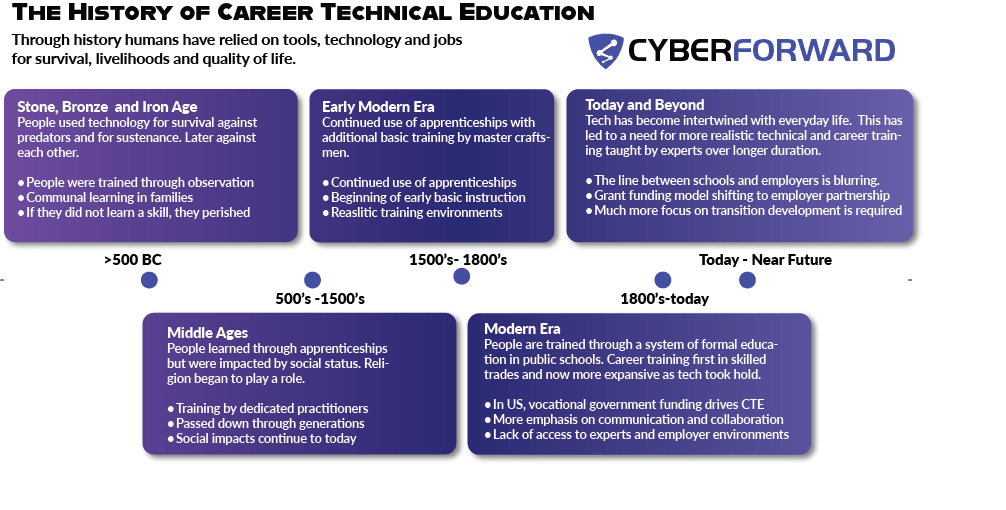
The history of career and technical education starts at the beginning of humankind. This is when humans began using tools as technology and had the very first jobs. As a result, they also required skill development techniques, many of which are still very relevant today.
Why is it important to start the history of CTE so far back?
So while there were no formal schools back in the oldest of days, there were many lessons that are still relevant to building a world class career and technical education program today.
This includes how during in ancient times hunter gathers used the most realistic of training environments. Also, people trained and developed with direct access to expert coaches. Or the quality early uses of apprenticeships during the middle ages. Further, throughout time how societal impacts such as class and religion were addressed (or weren’t).
Finally, if you just start with the modern era history, which most educators do, you will see that little has changed since 1917 and the Smith Hughes National Vocational Act.
In the modern era, CTE has been a school over employer driven approach. In this model, schools depend on grant funding to launch vocational programs. This has not worked well as many of these programs do not engage the very employers they hope to develop future workers for.
(Great) teachers then teach the programs, but they often lack practical experience in the fields in which they are delivering instruction. So lets go over the history of CTE so we can learn from our past to then shape our future.
Stone, bronze and iron ages
During the stone, bronze and Iron ages career and technical development definitely evolved. In the stone age, we saw the first demonstrations of how people learned technical skills through practical experience and daily survival needs.
Technical advancements like generating heat through making fire and weaponry like spears definitely then led to a need to train others how to use these technologies.
Further, if you have ever watched an episode of the tv show “Survivor” today, you can see the level of skills it takes to make something like fire. As a result, young students during this time learned these concepts by observing and imitating older members of their communities.
Since communities and groups were small, these students had the advantage of close access to experts. Most of this training used the primary tools of the time. You guessed it, stones for making various technologies and uses.
Bronze Age history of career and technical education
As time passed into the bronze age, we saw the introduction of the first apprenticeships. Developing students gained skills like metalworking and military tactics by working with experienced professionals.
There was a high value on practical experience and passing down knowledge over time. This was also when we really started seeing societal impacts as the communities people lived in started to grow. In many instances, and very much aligned to today, ones social status impacted what training they could receive.
Iron Age CTE considerations
As we moved into the Iron Age, the impacts of class and societal roles continued to play an even larger role. In addition, we had a major technological advancement during the Iron Age which led to the ability to create even more technologies. You probably guessed it again, the ability to smelt iron.
This led to even more military based apprenticeships to develop and then use these metal weapons and objects. This also led to a need for even more specialization related to craftmanship and training others to work with these materials.
Middle ages history of career and technical education
In the middle ages, up until the 1500’s, training mechanisms became more advanced as again tools became more advanced and specialized. Further, social class and religious influences continued to again dominate who received training and their associated opportunities.
This was the age of knights and nobles on one side of training privilege and peasants on the other. The elite went through rigorous physical training using the developing tools and weapons of the time. As important, this also started the age of chivalry with how to act and behave in all situations.
On the other side of the spectrum you had peasants who mostly learned practical skills related to their work. Few people were given formal schooling beyond what was taught through religion.
This access gap during this time looks very similar to the gap of opportunity we are experiencing today in the United States. Interesting how some things do not change other then time.
Early Modern Era
In the Early Modern era, from the 1500’s-1800’s, there continued to be many technical inventions, as well as philosophies on how to use them. Notable inventions included the printing press and steam engine. As these technologies and others became more complex and significant, the time of the master craftsman in using them further emerged.
These experts would then train individuals through an even more advanced system of apprenticeship. In these models, apprentices would work under these experts for set time periods in the desired craft.
The master delivered this training in a residency model, with the apprentice living with them. In addition to the primary skill training, the model also started supporting basic education in their chosen field as they developed advanced skills. This method was particularly prevalent in manual labor occupations such as blacksmithing, carpentry, and tailoring.
Modern Era in the history of career and technical education
The modern era, or 1800’s until today, begins the age of school driven career and technical training. There are still some apprenticeships.
However, they are focused on just a small segment of trade disciplines. In addition, as factories grew, some employer specific training was provided in order to operate machinery. Further, as we near today, digital technology and the Internet that connects it dominates how we live and work.
During this time, and up until today, primary education is delivered through formal education at public schools. This is where the basics such as math, managing social settings and the ability to read are delivered. Further, outside of the trades, this is where career and technical training is delivered to students.
Grant based approach to career training
From a career and technical training perspective, the modern era is also where the grant based approach to delivering technical training begins. And continues until today. What this means is that schools look to identify different grants, with varying requirements, which are then used to fund the vocational program.
This has led to an educator over employer approach. Schools do things to get funding, which don’t always align with best readying students for careers.
Most instruction is delivered by great teachers. However, they often lack practical expertise and experience in career specific disciplines. Schools also have difficulty replicating the realistic technical and business environments at their schools for students to practice.
Finally, the grant based model is very different then the capitalistic models of businesses leading to economic disconnects. Students are trained to align to academic standards, not business related or ones related to economic success.
Today and beyond the history of career and technical education
As we move forward, we need to change our approach to best develop and optimize our technical talent. This includes taking many of the great lessons learned from our past and combining them with innovative approaches for our future. Some of the items we should leverage, that we can take from our past, include:
- Provide close access to experts for those that are training
- Enabling realistic training environments for development
- A focus on execution and quality in task proficiency working with 21st century skills.
- Communal and team based approaches to solve problems
- The original dedicated approach to apprenticeships
Further, we also need to use our lessons learned of things that have not been optimal from our past. These include:
- Societal class based approach to who can get technical skills and training
- A grant based approach to delivering technical training
Next Steps
With these past experiences in mind perhaps it is now time to integrate them into a world class career and technical education program for my school. If you are looking for some help you may also want to review some educator related programs you can bring to you school.
Related Stories

What is career and technical education (CTE) curriculum?
[read_meter] What is Career and technical education (CTE) curriculum? A teacher uses the comprehensive…


