[read_meter]
What are career and technical education teachers?
Career and technical education teachers provide instruction, guidance and support to students training for vocational jobs. These instructors are often employed by public, private or post secondary schools to teach CTE programs.
Key responsibilities of CTE teachers
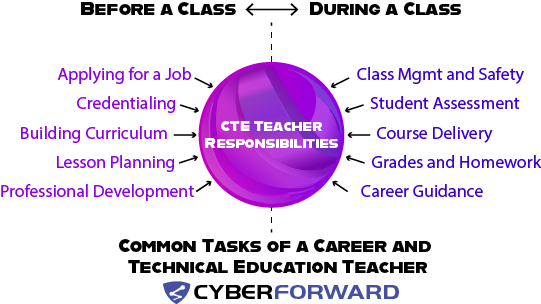
CTE teachers are a major part of delivering great vocational programs at schools. Below are some of their key responsibilities broken up between common tasks before teaching a course and then during a course.
Before teaching a course
Some of the key responsibilities of a teacher before delivering a course include:
- Applying and getting a hired for a CTE teaching job
- Navigating education logistics such as alignment to standards
- Building or selecting curriculum for the courses they will teach
- Developing lesson plans for their classes
- Getting credentialed or certified in order to be able to teach
- Building career and technical experience in their course areas
While teaching a course
Once a course begins, below are some common instructor tasks and responsibilities.
- Prepping for classes
- Ensuring configuration and safety of classroom equipment
- Delivering proficiency assessments
- Career counseling and coaching
- Delivering courses and managing classrooms
- Grading homework and providing feedback
- Providing overall grades to students
Important considerations with career and technical education teachers
Becoming a career and education teacher can be very rewarding. With that said, here are some common considerations for CTE instructors.
Growth of technology
As technology has continued to grow and impact every aspect of our lives, the need for technical skills and talent has never been greater. As a result, there is a strong demand for career and technical education programs that can develop this talent.
Job outlook for career and technical education teachers
Overall, the employment growth of teachers is set to remain the same over the next decade. However, CTE is a bit different as the the need for CTE classes has grown. So according to a study by Brookings, schools administrators are only able to find and staff instructors in CTE subjects 57% of the time. This is much higher then only 39% of the time in regular subjects.
Credentialing Process
In most CTE programs at public schools, instructors need to get an appropriate teaching credential. For vocational programs, this is often a combination of educational experience, certification courses, as well as work experience in the necessary areas of instruction.
CTE Teacher Pay
According to the U.S. Bureau of Labor statistics, CTE teachers have a medium pay of $63,580. It should also be mentioned that gaining technical skills as a CTE teachers also creates additional work and earning possibilities outside of teaching. Further, you need less experience to become a CTE instructor than to be a professional in the field. As a result, it might make sense to start a technical teacher and then moving into a professional position.
Should I be a career and education teacher or coach?
It takes years for developing technical talent to become proficient in most vocational careers in areas such as IT, culinary or cybersecurity. In entry level courses, where students are just learning the basics, a teacher might be the right type of instructor.
However, as students develop proficiency and transition to more of a worker, a CTE coach is often a better fit. This is because coaches are more familiar with providing direct feedback within work situations then a teacher may be.
Next Steps
Keep reading to discover techniques for recruiting top-tier teachers for your program or finding skilled CTE coaches. At CyberForward Academy, we partner with educators to design leading CTE programs. Explore our educator pathway or meet with us to discuss opportunities and potential partnerships.
Related Stories

What is a career and technical education coach?
[read_meter] What is a career and technical education coach? A career and technical education…